

Advanced machine learning models that learn your network’s unique behavior, predict problems before they happen, and help you make smarter decisions about water operations.
Fixed thresholds and manual analysis generate false alarms while missing subtle problems. Every network is different, generic rules don’t work.
We train machine learning models on your specific network data. The AI learns what’s normal for your system and alerts you when something changes.
We analyze 3-6 months of your historical data, pressure, flow, consumption patterns.
AI learns your network's normal behavior, daily cycles, seasonal changes, local patterns.
Models analyze live data continuously, comparing current vs. learned baseline behavior.
You get instant notifications when the AI detects anomalies, with location and likely cause.
Each machine learning model solves a specific challenge in water network management.
Identifies unusual patterns in pressure, flow, and consumption data that indicate leaks, bursts, or equipment failures.
Predicts water consumption patterns hours to weeks ahead, accounting for weather, seasons, events, and historical trends.
Tests thousands of operational scenarios to find the best pressure settings, pump schedules, and valve configurations.
Understands questions in plain language and explains complex network data in simple terms anyone can understand.
Generic AI doesn’t work for water networks. We train models specifically on your utility’s data for maximum accuracy.

Base models pre-trained on water network data from utilities worldwide. Gives AI general knowledge of how water systems work.

Fine-tune models using 3-6 months of your historical data. AI learns your topology, pipe materials, seasonal patterns, consumption profiles.

First 30-90 days, models run alongside existing systems. We review predictions, adjust thresholds, fine-tune based on real performance.

Models update automatically as your network evolves. Weekly retraining for fast patterns, monthly for seasonal baselines. Gets smarter over time.
Every water network is unique. Generic AI gives generic results. Our approach delivers accuracy you can trust.
Every utility has unique characteristics, pipe materials, terrain, consumption cycles, climate impacts.
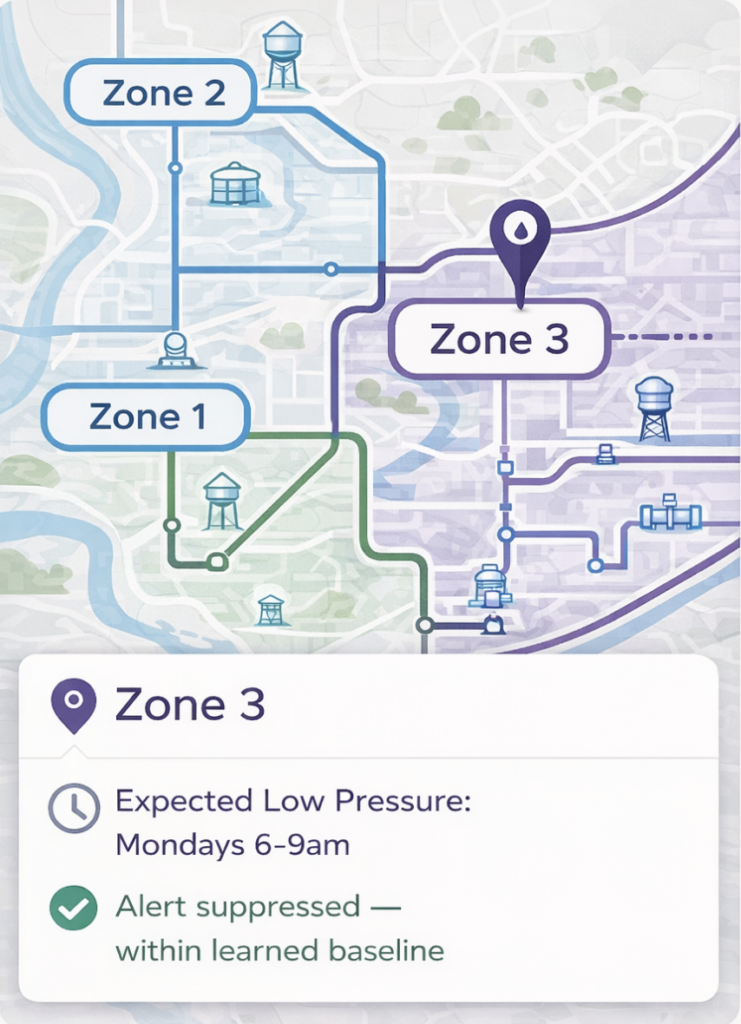
Example: AI learns that your Zone 3 always has lower pressure on Monday mornings, so it doesn’t falsely alert.
We don't pool data across clients. Your operational intelligence remains confidential and gives you competitive advantage.
Result: Performance improvements benefit only your utility, not your competitors.
The longer you use Flowless, the smarter it gets. Models adapt to infrastructure changes, consumption shifts, seasonal variations.
Data: Utilities using Flowless 2-3 years see 30-40% accuracy improvements vs. initial deployment.
This AI technology powers intelligent features in WaterCloud, Octopo, and Digital Twin.
Analytics platform
AI assistant
Simulation platform
These are the questions we hear most often from operators and engineers working in real networks.
Traditional systems fire alerts based on fixed rules. AI learns what “normal” looks like for each zone and time period, so it flags only meaningful anomalies and cuts down false positives over time.
Yes. AI detects subtle pressure, flow, and demand patterns linked to hidden leaks and losses, often earlier than manual analysis or rule-based monitoring.
You get value quickly, but accuracy improves as the system learns your network. As more data is observed, the AI adapts to seasonal demand, operational changes, and network behavior.
AI supports decisions, it doesn’t replace them. It surfaces risks, trends, and anomalies clearly, while engineers stay in control of validation and response.
Let's show you what to expect, accuracy rates, timeline, and projected results based on utilities like yours.