
Summary: Despite the rise of AI coding assistants and low-code platforms, building custom water analytics software remains a poor strategic choice for most utilities. The complexity of modern software development—from AI integration to cybersecurity—has actually widened the gap between in-house capabilities and specialized software companies. Utilities should focus on their core mission: delivering reliable, sustainable water services.
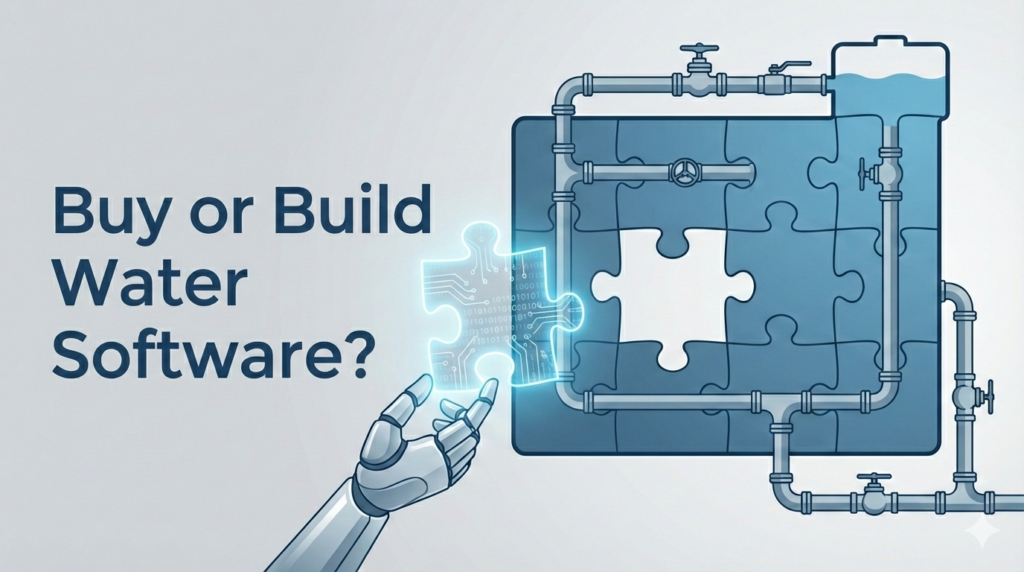
The build vs buy water software decision is one I’ve discussed with dozens of utility managers over the years. Should we build our own data analytics platform, or buy from a specialized vendor? It’s a question that keeps coming up—and for good reason.
Some have already tried building in-house. A few have even shown me what they’ve built—Excel dashboards connected to SCADA systems, custom Python scripts running on a server under someone’s desk, or ambitious full-stack applications that stalled halfway through development.
The answer I give them might surprise you, coming from someone who sells software: the build vs buy decision isn’t actually that complicated for most water utilities. Here’s why.
Why the Build vs Buy Water Software Decision Matters
The build versus buy question isn’t new. Enterprises across every industry have wrestled with this decision for decades. But the water sector presents unique challenges that tilt the equation strongly toward buying.
According to Forrester’s State of Application Development report, 67% of software projects fail due to incorrect build vs buy decisions. For water utilities—organizations whose core competency is delivering safe, reliable water—that failure rate represents an unacceptable risk.
Consider what modern water analytics software actually requires:
Real-time data integration from SCADA, GIS, billing systems, and IoT sensors. Each integration point is a potential failure mode that requires ongoing maintenance.
Cybersecurity compliance that meets increasingly stringent regulatory requirements. Water infrastructure is classified as critical infrastructure, making security non-negotiable.
Scalability and reliability that matches the 24/7 nature of water operations. Your system can’t go down at 3.00AM when you need it to automate pumps operations.
User experience design that operators will actually adopt. Complex analytics are worthless if field teams won’t use the tool.
So the question is: can utilities realistically build their own reliable and scalable water software?
The Hidden Costs of Building Custom Water Software
The motivation behind owning your technological stack is evident. Everyone needs as much autonomy as possible, but autonomy comes with a costly price!
When a utility attempts to build custom software, they’re essentially saying: “We’re going to become excellent at software development while maintaining excellence in water operations.” The math doesn’t work.
Consider the real costs:
Direct development costs typically run $350,000 to $550,000 annually for a serious enterprise application if you wish your homegrown software up to date and delivering the required value. Even before you reach that point, you need to invest significantly in the initial development of the software. That’s before you account for the opportunity cost of diverting technical talent from operations. There is a reason why software providers charge a lot for their services.
Ongoing maintenance consumes 15-20% of the original development cost annually. Bug fixes, security patches, compatibility updates—the work never ends.
Technical debt accumulates faster in organizations where software isn’t the core focus. McKinsey reports that CIOs estimate technical debt makes up 20-40% of their entire technology estate’s value.
Staff turnover in tech roles averages 36% annually. When your one developer who understands the custom system leaves, you’re back to square one.
A reliable software platform cannot be built and maintained unless software development is the core focus of the organization.
This isn’t a criticism. It’s simply how specialization works. Water utilities excel at water treatment, distribution network management, customer service, and regulatory compliance. Those capabilities took decades to develop. Software companies excel at building, deploying, and maintaining software systems.
Has AI Changed the Build vs Buy Software Equation?
With ChatGPT writing code, GitHub Copilot suggesting functions, and low-code platforms promising apps without developers—surely building custom software is easier than ever?
The reality is more nuanced.
Yes, AI tools have made individual coding tasks faster. A skilled developer can prototype features more quickly than ever before. Even people with no coding background can now develop and ship software fast. But these same advances have also raised the bar for what users expect from software. The gap between “functional prototype” and “production-ready, scalable, and reliable platform” has actually widened.
Here’s what AI hasn’t solved:
System architecture decisions that determine long-term scalability and maintainability. AI assistants can write code, but they can’t design robust systems that evolve with your needs.
Domain expertise in water network hydraulics, pressure management, and NRW reduction methodologies. Generic AI tools don’t understand the difference between a legitimate night flow pattern and a leak signature.
Continuous improvement based on deployments across multiple utilities. Every bug we fix, every feature we add at Flowless comes from real-world learning across four continents.
Security hardening against increasingly sophisticated threats. Cybersecurity in water systems isn’t a one-time implementation—it’s an ongoing battle that requires dedicated expertise. How can you ensure that a vibe-coded software is safe for handling your infrastructure?
What About Security Concerns with Water Software?
“We’re nervous about putting our operational data in someone else’s system.” say many water professionals globally.
It’s a valid concern. Water infrastructure is critical infrastructure, and the consequences of a security breach can be serious. But consider this: which scenario is actually more secure?
Option A: A custom-built system maintained by a small team with limited security expertise, running on infrastructure managed alongside dozens of other IT priorities.
Option B: A purpose-built platform from a company whose entire business depends on security, with dedicated security staff, regular penetration testing, and compliance certifications that clients require.
The good news is that you can always ensure your data is secure even if it’s hosted on the cloud. That’s why compliance requirements like ISO 27001 and GDPR were developed. There would always be a security risk, but the question is how you can ensure that those risks are minimized and controlled, not eliminated.
Your Build vs Buy Water Software Decision Framework
If you’re still weighing this decision, here’s a practical framework to help you take the decision:
Build only if:
The problem you’re solving is truly unique to your organization. Software development is (or will become) a core strategic capability within your organization. You have budget for 3-5 years minimum of development and maintenance, and you plan to allocate more afterwards and on the long run. You can attract and retain software engineering talent (which is much harder than you might think, especially if you’re asking for highly required talent like AI engineers). Your organization has tolerance for the inherent delays and failures of software projects.
Keep in mind: McKinsey research shows that large IT projects run 45% over budget and 7% over time, while delivering 56% less value than predicted. The Standish Group CHAOS Report found that 35% of large enterprise custom software initiatives are abandoned entirely, with only 29% delivered successfully.
Buy if:
Your challenge (leak detection, NRW reduction, pressure management) is shared by utilities globally. You want to benefit from improvements driven by deployments at other utilities. Your team’s time is better spent on water operations and ensuring proper water supply than software maintenance. You need a solution within weeks, not months or years. Security and compliance are non-negotiable requirements.
What Utilities Should Focus On Instead of Building Software
Utilities achieving world-class NRW rates below 10% aren’t doing it because they built better dashboards. They’re doing it because they built better processes, trained better teams, and created cultures of continuous improvement.
The technology is an enabler, not the differentiator.
What should your technical team focus on instead?
Data quality and integration: Ensuring your supply, production, GIS, and billing data is accurate and accessible. No software—bought or built—can compensate for garbage data.
Process optimization: Designing workflows that translate software alerts into field action. The gap between detection and repair is where NRW reduction actually happens.
Team capability building: Training operators to interpret data, prioritize interventions, and measure results. Technology amplifies human capability—it doesn’t replace it.
Vendor management: Building productive relationships with technology partners who understand your operational context. The best software implementations are collaborations, not transactions.
As Deloitte’s digital transformation research consistently shows, technology adoption success depends far more on organizational readiness and change management than on the specific technology chosen.
The Path Forward for Water Utilities
If you’re currently debating whether to build custom water analytics software, I’d encourage you to reframe the question.
Instead of asking “Can we build this ourselves?” ask “What would our utility accomplish if we invested those resources in operational improvement instead?”
The water sector faces enormous challenges: aging infrastructure, climate change impacts, workforce transitions, and rising customer expectations. Meeting these challenges requires focus—and that means letting specialists handle specialization.
At Flowless, we’ve spent years building water analytics capabilities so utilities don’t have to. We’ve learned from deployments in Brazil, Oman, Kenya, and more. Every lesson, every improvement, every security hardening benefits all our clients.
That’s the real advantage of the buy approach for water software: you’re not just purchasing software. You’re purchasing the accumulated expertise of a team whose entire focus is solving your exact problem.
Key Takeaways
The build vs buy water software decision strongly favors adopting software developed by specialized firms for most, if not all, utilities. AI and low-code tools have not closed the gap—they’ve raised user expectations while software complexity continues to increase. Security concerns actually favor specialized vendors over in-house development. Utilities provide more value for the end-consumers through operational excellence, not custom software. Resources spent on building software are resources diverted from core water operations.
FAQ
Can AI tools help utilities build their own water software?
AI coding assistants can accelerate individual tasks, but they don’t address the fundamental challenges: system architecture, domain expertise, security hardening, and continuous improvement based on multi-utility deployments. The gap between prototype and production-ready, reliable, and sustainable system has actually widened.
What about data security with external water software vendors?
Purpose-built platforms from specialized vendors typically offer stronger security than in-house alternatives. Companies whose business depends on security invest in dedicated staff, penetration testing, and compliance certifications at levels individual utilities cannot match.
When does building custom water software make sense for utilities?
Building makes sense only when the problem is truly unique to your organization, software development is a core strategic capability, you have budget for 3-5 years of development, and you can attract and retain engineering talent. For most water utilities, none of these conditions apply.
Ready to focus on what matters? Schedule a demo to see how Flowless helps utilities reduce NRW without the burden of building and maintaining custom water software.

Baker Bozeyeh
Flowless Co-founder & CEO