
Non-revenue water costs utilities billions every year. Water leaves the treatment plant but never reaches a customer’s meter. It leaks through aging pipes, disappears at faulty connections, or goes unrecorded due to meter errors.
Traditional leak detection relies on manual surveys. Crews analyze pressure data in spreadsheets and make educated guesses about where problems exist.
What if your network could tell you exactly where water is disappearing and why?
That’s what generative AI makes possible. But not the generic AI you hear about in the news. We’re talking about AI specifically trained on water utility operations.
Understanding Generative AI for Water Networks
Generative AI works differently than traditional analytics software.
Traditional systems follow programmed rules. If pressure drops below X, trigger an alert. If flow exceeds Y, flag the zone. These rules work, but they’re rigid.
They can’t adapt to your network’s unique patterns or answer questions outside their programmed rules.
Generative AI learns from patterns in data. It builds understanding of what normal looks like in your specific network, then identifies deviations that matter. More importantly, it can respond to natural language questions and generate explanations in plain terms.
Here’s the technical foundation:
- Large Language Models (LLMs) process text and understand context. They learn relationships between concepts by training on massive datasets. Ask a question, and they generate responses based on patterns they’ve learned.
- The limitation with generic AI? It’s trained on general internet content. It knows nothing specific about your water network, your consumption patterns, or your infrastructure challenges.
- The solution? Train the model on water utility data specifically.
How Flowless Trains AI for Water Operations
Flowless doesn’t use generic AI models. We train large language models specifically on water utility operations data.
This means the model learns from:
- Historical consumption patterns across different network zones
- Pressure and flow relationships in distribution systems
- Leak signatures and anomaly patterns
- Maintenance records and intervention outcomes
- Seasonal variations and demand cycles
- Infrastructure characteristics and failure modes
The model understands water network operations because it’s trained on water network operations. Not general knowledge scraped from the internet.
Why this matters:
When you ask “Why did Zone 3 show elevated nighttime flows last Tuesday?”, a water-trained model knows:
- What nighttime flows typically indicate (possible leaks)
- How Zone 3 normally behaves at night
- What “elevated” means in your network’s context
- What factors could cause this pattern
- What actions typically resolve similar situations
A generic AI model couldn’t provide this depth because it lacks domain expertise.
The technical approach:
We use a combination of supervised learning on labeled water utility datasets and fine-tuning on daily usage patterns. The model learns to recognize:
- Leak detection patterns
- Network anomalies
- Pressure management scenarios
- Consumption Unusual consumption patterns
- Infrastructure risk factors
This training creates a model that thinks like a water utility expert, not just a general-purpose chatbot.
Meet Octopo: Flowless’s AI Agent for Water Networks
Octopo is Flowless’s AI-powered assistant built specifically for water network operations. It’s the practical application of our water-trained language model.
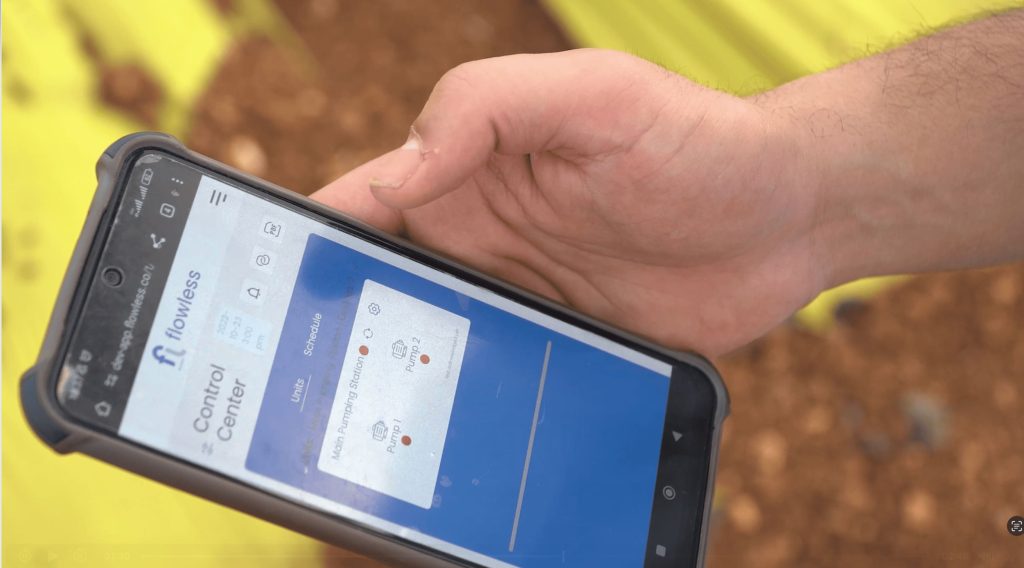
Instead of building more dashboards or creating complex reports, Octopo lets operators have natural conversations with their network data. You ask questions in plain language. The system analyzes your real-time and historical data. You get specific answers with context.
How it works technically:
Octopo connects to your existing data infrastructure through APIs. It doesn’t replace your SCADA, AMI, or monitoring systems. It sits on top and makes all that data accessible through plain language questions.
When you ask a question, here’s what happens:
1. Natural Language Processing The system interprets your question. It figures out what data you need, what analysis to run, what time frame matters, and which part of the network you’re asking about.
2. Data Pipeline Execution Octopo queries your relevant data sources. Flow meters, pressure sensors, consumption records, maintenance logs, whatever information addresses your question. All processing happens securely within your infrastructure.
3. Water-Specific Analysis This is where water utility training matters. The model analyzes data through the lens of water operations expertise. It understands hydraulic relationships, leak patterns, consumption behaviors, and network anomalies specific to water distribution.
4. Contextual Response Instead of returning raw data or generic charts, Octopo generates an explanation. It tells you what the data shows and why it matters in your network’s context. It also recommends actions that typically address similar situations.
This entire process takes seconds. You get clear answers without spending hours in analysis.
What Octopo Makes Possible for Water Operators
The shift from traditional analytics to AI assistants changes how operators work daily.
Fast Answers to Complex Questions
Operators can ask direct questions and get immediate insights:
“Which zones showed unusual nighttime consumption last night?”
“Where are current pressure levels outside the optimal range?”
“Show me historical leak patterns in Zone 3.”
“Compare this week’s consumption to the same period last month.”
The system analyzes multiple data sources simultaneously and provides specific answers. Not dashboards to interpret. Not reports to read through. Direct answers to daily questions.
Context, Not Just Data
When flow data shows a spike, traditional systems display the graph. Octopo explains what’s happening:
“Zone 3 shows 40% higher flow than baseline at 2 AM. Pattern consistent with leak signatures. Pressure dropped 15% simultaneously. Recommend immediate inspection of high-pressure zones.”
The analysis happens across pressure data, flow patterns, time of day, historical behavior, and network characteristics. Operators get context that tells them what to do next.
Unified Data Access
Most operators work with data scattered across multiple platforms. SCADA for real-time flows. GIS for network layout. Maintenance systems for repair history. Billing platforms for consumption patterns.
Getting one answer requires logging into three systems and piecing information together manually.
Octopo integrates these data sources. Ask one question, get a synthesized answer from all relevant systems. The integration happens through secure APIs; your existing infrastructure stays in place.
Octopo’s Role in Managing Non-Revenue Water
Non-revenue water reduction requires finding leaks fast, prioritizing interventions effectively, and tracking results accurately. Octopo addresses all three.
1. Finding Leaks Faster
Traditional leak detection follows scheduled surveys. Crews survey zones with acoustic equipment. Many zones they check have no leaks. Hours spent searching where nothing’s wrong.
Octopo changes this approach. The system analyzes pressure patterns, consumption data, network characteristics, and real-time leak locations. It identifies zones most likely to have leaks.
Operators ask: “Which zones should we prioritize for leak surveys today?”
Octopo responds with specific zones ranked by likelihood, along with supporting evidence: unusual pressure drops, elevated nighttime flows, consumption anomalies. Crews focus time where leaks actually exist.
2. Real Results: SABESP Brazil
Alexandre Marques manages operations for SABESP’s Eastern Regional Directorate in Brazil. When his team deployed Octopo in a pilot area, the rapid anomaly detection changed their response time.
“The agility of the software and fast detection of anomalies helped in faster decision making,” Alexandre says.
The outcome: 9% water loss reduction in the pilot area.
The difference wasn’t new infrastructure or additional staff. It was identifying problems faster and directing resources to the right places.
Smarter Decisions About What to Fix
Reducing NRW requires smart decisions about which problems to fix first with limited resources.
Octopo helps operators evaluate: Which leak locations cause the most water loss? Which zones have the highest financial impact? Where will repairs deliver maximum return?
The analysis combines volume data, network characteristics, repair difficulty, and revenue impact. The platform delivers prioritized recommendations to operators using real business impact, not only technical severity.
As interventions happen, Octopo tracks changes: minimum night flow improvements, pressure optimization results, consumption pattern changes.
Operators can query: “Show me water loss trends since we completed repairs in Zone 5.”
This visibility shows which interventions work and which require different approaches.
The Technical Foundation That Makes This Possible
What separates Octopo from generic AI tools is the water utility-specific training and operational design.
Domain-Specific Language Model: This AI model is trained on real water utility data, so it understands water network terminology, hydraulic relationships, and operational patterns.
It knows what “minimum night flow” means, why it matters, and how to interpret it in context.
Secure Data Integration Octopo connects to existing systems through secure APIs. Data never leaves your infrastructure. Processing happens within your environment. The system reads your data but doesn’t store or transmit it externally.
Continuous Learning Architecture As operators use Octopo, the system learns patterns specific to your network. It adapts to your infrastructure characteristics, consumption patterns, and operational priorities.
The model gets smarter about your network over time while maintaining the core water utility expertise from its training.
Who Benefits From This Approach
Octopo delivers the most value to utilities facing these challenges:
Complex networks with multiple data sources where operators spend significant time gathering information before they can make decisions. The integration layer eliminates this bottleneck.
Limited technical staff stretches engineering expertise thin. Octopo amplifies operator effectiveness by providing analysis that would otherwise require specialized skills.
High non-revenue water, where finding and prioritizing leak interventions drives financial performance. The intelligent detection and prioritization directly impacts bottom-line results.
Pressure management programs that need to balance water leak reduction with service requirements. The pressure-leakage analysis helps optimize setpoints across zones.
Growth utilities where network complexity increases faster than staff capacity. The AI scales analysis capability without proportional staff increases.
The system works for utilities of any size. What matters is having data infrastructure (SCADA, smart meters, pressure monitoring) and wanting to use that data more effectively.
Getting Started With Water-Trained AI
Implementing generative AI for NRW management doesn’t require replacing your current systems. Octopo integrates with existing infrastructure through APIs.
The key requirements:
Data infrastructure in place – SCADA systems, smart meters, or pressure monitoring generating operational data. The quality and frequency of data impacts the quality of insights.
Clear NRW objectives – Specific goals like reducing water loss percentage, detecting water leak fast, or optimizing pressure management. The system performs best when addressing defined operational challenges.
Operational buy-in – Operators who will use conversational AI in daily workflows. The technology only delivers value if people actually use it.
Most deployments start with a pilot area, similar to SABESP’s approach. This allows operators to learn the system, validate results, and build confidence before expanding across the full network.
The goal isn’t implementing AI for its own sake. It’s reducing non-revenue water more effectively than traditional approaches allow.
Ready to see how water-trained AI analyzes your network data? Explore Octopo’s capabilities →

Naser Shanti
AI & ML Engineer