
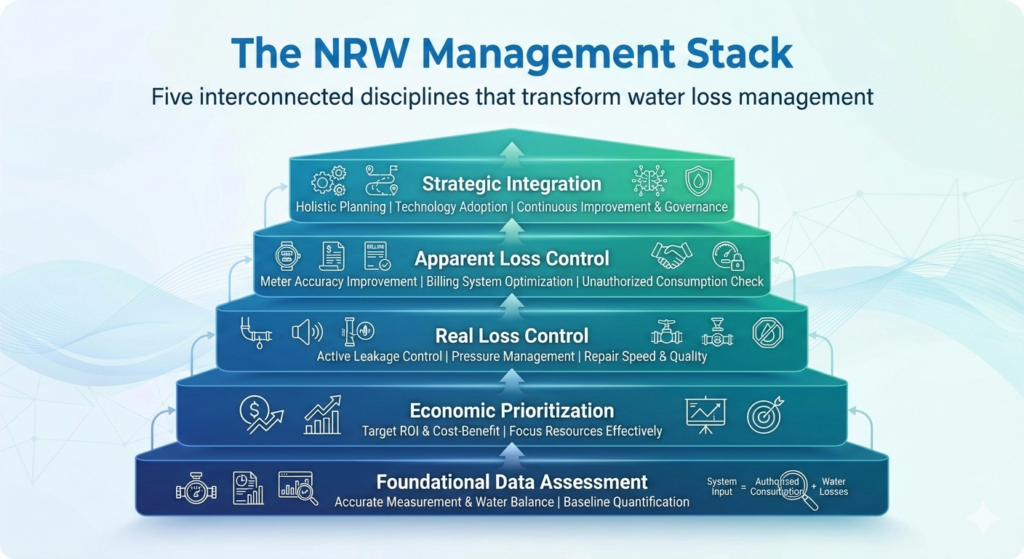
Most utilities focus on fixing leaks while ignoring the strategic framework that makes NRW reduction sustainable. High-performing teams master five interconnected disciplines: foundational data assessment, economic prioritization, real loss control, apparent loss control, and strategic integration. Together, these form an “NRW management stack” that transforms water loss from a recurring headache into a systematically managed business function.
Every year, the same pattern plays out across utilities worldwide.
An ambitious NRW program launches. Teams work overtime. Budgets flow. Leaks get fixed. The numbers improve.
Then, quietly, water loss creeps back up. Targets slip. The cycle repeats.
I’ve watched this happen dozens of times. And here’s what frustrates me most: it’s entirely preventable.
The utilities that consistently crush their NRW targets year after year aren’t just better at fixing leaks. They’ve built something fundamentally different – what I call an “NRW management stack.” They’ve stopped treating water loss as a problem to solve and started building it as a capability to sustain.
For the past decade, I’ve been studying what separates high-performers from the rest. The answer isn’t fancy equipment or bigger budgets. It’s mastering five interconnected disciplines that most utilities completely ignore.
Why Most NRW Programs Fail
The typical utility massively over-invests in physical leak detection while barely touching everything else. They’re obsessed with finding leaks without understanding whether they’re finding the right leaks, whether the economics justify the intervention, or whether commercial losses are silently draining more revenue than all those physical leaks combined.
It’s like building a skyscraper by starting with the penthouse. You can’t install the roof before laying the foundation. Even a solid foundation is useless without walls to support what comes next.
That’s the problem. Most utilities are operating without a coherent structure. They’re implementing solutions in isolation, wondering why nothing sticks.
What is an NRW Management Stack?
An NRW management stack is a layered system where five disciplines work together to drive continuous improvement. Each layer builds on the one below it. Progress in one area reinforces progress in others.
The five layers are:
Foundational Data Assessment – establishing a credible baseline
Economic Prioritization – targeting ROI, not just volume
Real Loss Control – managing physical leakage systematically
Apparent Loss Control – protecting revenue through commercial optimization
Strategic Integration – connecting insights to decisions
Master all five, and NRW stops being a recurring crisis. It becomes the backbone of how your utility operates.
Let me walk you through each one.
Discipline 1: Foundational Data Assessment
The principle: You cannot manage what you cannot measure.
Before launching any reduction initiative, you need to know three things with confidence: how much water enters your system, how much is legitimately consumed, and where the gap comes from.
This is where the IWA water balance methodology becomes essential. It’s a systematic accounting of all water flows through your network, breaking system input into authorized consumption, apparent losses, and real losses. This framework is now used by utilities, regulators, and funding agencies worldwide – and for good reason.
How to Establish Your Baseline
Conduct an annual water audit. Use the IWA methodology (or regional equivalents like AWWA’s water audit) to quantify each NRW component. This isn’t a one-time exercise. Repeat it annually to track progress and catch emerging issues early.
Assess data validity. A water balance is only as good as the data feeding it. Assign confidence grades to each input: production meter accuracy, customer meter accuracy, estimated unbilled consumption. The IWA recommends a 95% confidence interval approach. If your data validity score is low, improving measurement infrastructure becomes the priority before setting aggressive targets.
Mistakes to Avoid
Setting targets before establishing baselines. Promising a 20% NRW reduction sounds impressive in board meetings, but if your baseline is unreliable, you’re measuring progress against noise.
Using percentage-based metrics in isolation. NRW as a percentage of system input is easy to calculate but deeply misleading for comparisons. A utility with intermittent supply shows lower percentage NRW simply because less water enters the system, not because they manage losses better.
Treating the water balance as a finance exercise. Operations teams need to own this data. If the people responsible for reducing losses don’t trust the numbers, they won’t act on them.
Discipline 2: Economic Prioritization
The principle: Stop fixing the biggest visible problem. Start targeting return on investment.
Here’s an uncomfortable truth: a leak-free network is not achievable. Even the best-maintained systems experience ongoing losses. The question isn’t whether you have leaks – it’s whether you’re spending resources wisely to control them.
This is where Economic Level of Leakage (ELL) becomes essential.
What is Economic Level of Leakage?
ELL is the point where the cost of further reducing leakage equals the cost of the water being lost. Below this level, every dollar spent on leak reduction returns less than a dollar in saved water. Above it, you’re leaving money on the table.
ELL isn’t fixed. It shifts based on cost of water production, cost of leak detection and repair, pressure in the network, and regulatory requirements. If your marginal production cost is high (expensive treatment, long-distance pumping, energy-intensive sources), the economic case for leak reduction strengthens.
How to Apply Economic Prioritization
Calculate your ELL. Work with finance and operations to model the relationship between leakage control investment and water savings. The IWA Water Loss Task Force has published methodologies for both short-run and long-run ELL calculations.
Compare current losses to economic losses. The gap between your Current Annual Real Losses (CARL) and your ELL represents economically recoverable water. This is where investment should focus.
Prioritize interventions by ROI. Not all leaks are equal. A small leak on a high-value transmission main may justify faster response than a larger leak on a low-pressure distribution line. Build prioritization frameworks that account for water value, repair cost, and customer impact.
Revisit annually. ELL relies on assumptions that change over time. Energy prices fluctuate. Detection technology improves. Regulatory expectations evolve. Treat ELL as a living target, not a one-time calculation.
Discipline 3: Real Loss Control
The principle: Implement the four pillars of leakage management together, not in isolation.
Real losses – physical leaks from mains, service connections, and storage facilities – typically represent the largest component of NRW. The IWA framework identifies four pillars: Active Leakage Control, Pressure Management, Speed and Quality of Repairs, and Infrastructure Management.
The mistake most utilities make is treating these as independent programs. In reality, they’re deeply interconnected.
The Four Pillars Explained
Active Leakage Control involves systematically detecting and locating leaks that don’t surface on their own. Techniques include acoustic listening, correlators, ground-penetrating radar, and increasingly, AI-powered flow analysis. The goal is reducing “awareness time” – the period between when a leak starts and when you know about it.
Pressure Management is often the most cost-effective lever for reducing real losses. Reduce average zone pressure by 10%, and you can expect a roughly proportional reduction in leak flow rates. Pressure management also reduces burst frequency, extending asset life. Many utilities overlook this because pressure reduction requires careful hydraulic modeling to avoid service impacts.
Speed and Quality of Repairs addresses how long it takes to pinpoint a detected leak and how long until it’s fixed. Reducing these intervals directly reduces water lost. Quality matters too – poorly executed repairs lead to repeat failures.
Infrastructure Management is the long game. As pipes age, background leakage increases and burst frequency rises. Strategic renewal programs, based on failure history, pipe material, soil conditions, and criticality, prevent losses before they occur.
Why Integration Matters
Consider this scenario: You invest in acoustic leak detection and find 50 leaks per month. But repair crews are already at capacity, so average repair time stretches from 3 days to 10 days. Meanwhile, system pressure remains high, so each unrepaired leak loses more water per hour. The detection investment is undermined by constraints in other pillars.
High-performing utilities coordinate across all four pillars. They align detection capacity with repair capacity. They use pressure management to “buy time” while repairs are scheduled. They feed failure data into renewal planning to prevent future leaks.
Discipline 4: Apparent Loss Control
The principle: Shift from reactive billing fixes to proactive revenue protection.
Apparent losses don’t involve physical water leaving the network. Instead, they represent water that reaches customers but doesn’t generate revenue – due to meter inaccuracy, data handling errors, or unauthorized consumption.
While apparent losses are typically smaller in volume than real losses, their financial impact can be comparable. Why? Because the “cost” of a cubic meter of apparent loss includes not just production costs, but the full retail tariff that should have been collected.
Components of Apparent Losses
Customer meter inaccuracy. Meters degrade over time, typically under-registering flow (especially at low flow rates). The older the meter fleet, the higher the cumulative under-registration.
Data handling errors. Mistakes in meter reading, data entry, billing calculations, and account management all contribute to unbilled consumption.
Unauthorized consumption. Illegal connections, meter tampering, and bypasses divert water without payment. The scale varies dramatically by region.
How to Control Apparent Losses
Implement performance-based meter replacement. Rather than replacing meters on a fixed schedule, use sampling programs to identify when specific meter types or age cohorts begin under-registering beyond acceptable thresholds. Replace strategically based on revenue impact.
Audit large customer meters. A single inaccurate bulk meter can dwarf the cumulative error from hundreds of residential meters. Prioritize testing and calibration for your highest-consumption accounts.
Improve data quality. Invest in automated meter reading or advanced metering infrastructure to reduce manual reading errors. Implement validation routines that flag anomalies for investigation.
The utilities that excel at apparent loss control treat it as “revenue protection” rather than “billing fixes.” This framing elevates the function from administrative cleanup to strategic priority.
Discipline 5: Strategic Integration
The principle: Connect insights to decisions and decisions to measurable outcomes.
The first four disciplines generate data. Strategic integration turns that data into action. This is where ROI becomes tangible – where insights turn into decisions and decisions turn into measurable savings.
What Strategic Integration Looks Like
Unified data platforms. GIS, SCADA, billing systems, and customer meters often exist in separate silos. Integrating them into a unified view allows you to correlate operational data with spatial and commercial information. When you see a flow anomaly, you can immediately access pipe age, material, pressure zone, and customer impact.
Predictive analytics. Historical patterns of failures, combined with asset characteristics and environmental factors, can predict which pipes are most likely to fail next. This shifts renewal planning from reactive (fix what’s broken) to proactive (prevent what’s likely to break).
Intervention ROI modeling. Smart platforms can calculate the expected return from repairing a specific leak, replacing a specific meter, or adjusting pressure in a specific zone – helping you allocate limited resources to highest-value actions.
Performance dashboards. Stakeholders at every level need visibility into NRW performance. Dashboards should show not just current status, but trends, targets, and the drivers behind changes.
The Integration Dividend
When the five disciplines work together, something powerful happens: your stakeholders always know what’s working, where the value is, and where resources should go next.
You’re no longer hoping NRW targets get met. You’re systematically reducing losses, clearly and consistently, year after year.
NRW reduction flows in cycles – new technologies arrive, old systems evolve, and breakthrough ideas slowly nudge their way into business as usual.
But the utilities winning consistently aren’t just adopting new tech. They’re building comprehensive capabilities that compound over time. They’ve stopped firefighting and started building systems that prevent fires from starting in the first place.
The five-discipline stack isn’t revolutionary. It’s just rigorous. And in a sector where most utilities are still winging it, rigor is your competitive advantage.
Ready to build your NRW management stack? Contact us to discuss how we can support your transition from reactive to systematic water loss management.

Baker Bozeyeh
Flowless Co-founder & CEO